If a prospective client asks you why their high-budget, professionally designed website isn’t showing up in ChatGPT, Perplexity, or Google AI Overviews, what’s your baseline answer?
For years, the standard agency answer to low search visibility was simple: build more backlinks, get more Google reviews, or write more blog posts.
However, in the era of Generative Engine Optimization (GEO) and AI search, those legacy metrics fail to explain why certain brands win AI citations while others — including industry leaders — remain completely invisible.
To illustrate this shift, I recently conducted a live “triangulation” GEO teardown analyzing three regional businesses in a high-ticket, local service sector ($500k+ average project value).
The findings show that traditional SEO agencies are often measuring the wrong things for modern search. More importantly, it highlights a clear opportunity for design, branding, and web development agencies to bring extra, high-margin value to their clients by offering real, entity-driven AI visibility solutions.
The Market Experiment: 3 Sites, 3 Failure Modes
I audited three competing regional websites across 20 live AI search queries spanning 4 major AI answer engines (ChatGPT, Perplexity, Gemini, and Google AI Overviews).
- Brand A (the baseline winner): earned a 45% AI visibility rate (cited in 8 of 20 query clusters).
- Brand B (the control competitor): earned a 5% AI visibility rate (cited in 1 of 20 clusters).
- Brand C (the invisible brand): earned a 0% AI visibility rate — completely unmentioned across all 20 AI query sets.
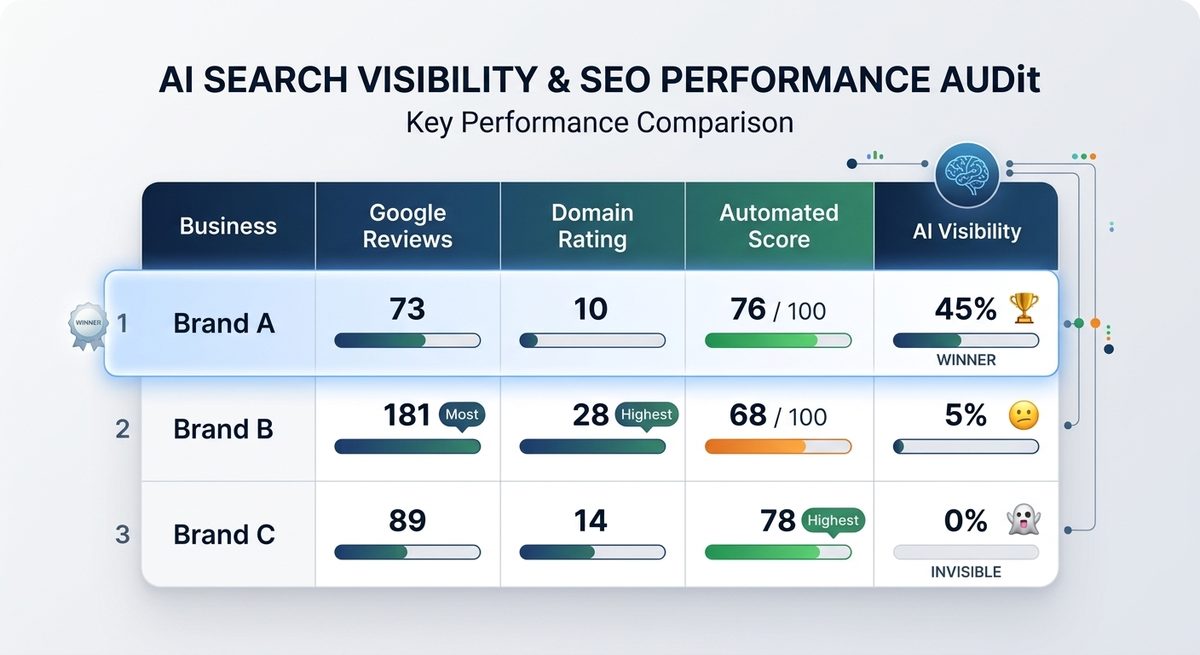
Here is where the counterintuitive truth of GEO emerges: traditional SEO metrics completely failed to predict these outcomes.
| Business | Google Reviews | Domain Rating | Automated Score | AI Visibility |
|---|---|---|---|---|
| Brand A | 73 (fewest) | 10 (lowest) | 76 / 100 | 45% — winner |
| Brand B | 181 (most) | 28 (highest) | 68 / 100 | 5% |
| Brand C | 89 (mid) | 14 (mid) | 78 (highest) | 0% — invisible |
Data compiled via live AI search sampling, JavaScript-rendered site crawls, and search authority index metrics. Visibility was gathered and scored with help from CiteRank.
Why the legacy playbook failed
- Reviews didn’t decide it: Brand B had more than double the Google reviews of Brand A, yet was virtually invisible in AI answers.
- Domain Rating (DR) didn’t decide it: Brand B had nearly triple the authority metric of Brand A — and lost badly.
- Automated “GEO” tools didn’t decide it: Brand C scored the highest on a third-party automated GEO readiness index (78/100) but was cited 0% of the time.
Automated audit tools and standard SEO metrics don’t reflect live AI search reality. Entity legibility is what actually dictates AI citations.
🎁 Free tool — run this teardown on your own brand
I’ve packaged the exact framework from this audit into a free AI Visibility Tracker spreadsheet. Log your citation rate across ChatGPT, Perplexity, Gemini, and Google AI Overviews and see where you — or your clients — actually stand.
Get the free AI Visibility Tracker →
Opens in Google Sheets — click “Make a copy” to save your own editable version.
Why Automated Audit Tools Need a “Human in the Loop”
Relying strictly on automated software creates massive blind spots. For example, during the crawl of Brand C, an automated audit tool flagged 30+ “orphaned pages” on the site.
To an inexperienced analyst — or an automated reporting dashboard — that looks like a major technical fault requiring hours of unnecessary remediation. But when I applied my 15 years of experience to manually review the crawl data, I verified those flagged URLs were simply standard paginated archive pages from older blog posts — not broken or orphaned content at all.
Automated tools generate false positives and misleading scores all the time. Real optimization requires a skilled human expert to interpret the data, filter out the noise, and focus on what actually moves the needle.
Diagnosing the AI Visibility Gap: The “Query Fan-Out”
When a buyer asks an LLM a complex intent question (e.g., “Who are the best design-build custom contractors in [City]?”), the engine doesn’t just run a single lookup.
It fans out — decomposing the prompt into underlying sub-queries (process steps, pricing breakdown, site selection, local permits). The engine retrieves a distinct source for each sub-query, then synthesizes a single answer.
Whichever brand provides the clearest, most extractable, entity-linked answer to those sub-questions earns the citation.
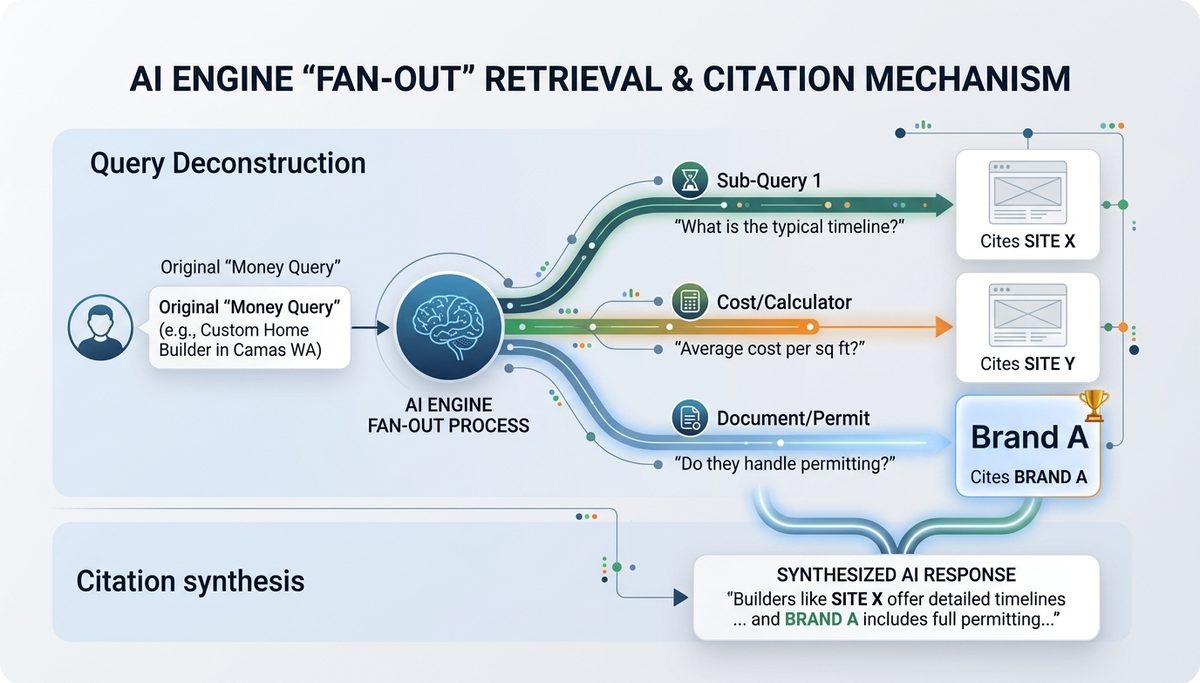
When I audited Brand C (the site with 0% visibility), I found genuinely great content — awards, project showcases, and local community guides. But it was published in gallery and announcement formats, not answer-structured or schema-connected content. The raw material existed, but AI engines had nothing extractable to cite.
Diagnose vs. Solve: A 4-Stage GEO Roadmap for Agency Partners
Diagnosing an AI visibility gap is only half the battle; executing the fix requires specialized technical precision. I structure this work into four distinct stages:
Stage 1 — Entity & Technical Architecture (Build)
- Connected
@graphschema: deploying explicit JSON-LD schema chains (LocalBusiness/GeneralContractor → Service → RealEstateListing → FAQPage → Person) connected viasameAsentity nodes. - Entity consolidation: unifying split-market identities so LLMs confidently map the business to its primary operating nodes.
Stage 2 — Fan-Out Content Optimization (Build)
- Answer-shaped content: restructuring money pages with question-framed H2 headings and concise, extractable lead paragraphs designed specifically for LLM parsing.
- E-E-A-T signaling: integrating explicit author attribution and credentialed Person schema to validate expertise.
Stage 3 — Managed Off-Page Authority (Manage)
- Entity corroboration: conducting field-level NAP (Name, Address, Phone) consistency audits across key regional directories and industry aggregators (using platforms like BrightLocal as a managed infrastructure layer, not a standalone product).
- Digital PR: securing placement in high-authority editorial listicles that AI engines frequently reference.
Stage 4 — Continuous Tracking & Defense (Measure)
- Engine re-scanning: monitoring citation rates across ChatGPT, Perplexity, Gemini, and Google AIO to track visibility movement over time.
The Agency Takeaway: Why White-Label Expertise Matters
Many traditional agencies are currently cutting costs by leaning on automated AI tools or entry-level staff to auto-generate content. But as this teardown demonstrates, automated software cannot diagnose why a well-designed website is unreadable to AI engines.
Winning in modern search requires an expert human in the loop — someone who understands technical entity architecture, schema graphs, and LLM extraction mechanics.
By partnering with an independent GEO specialist, web development and branding agencies can offer deep, transparent AI search optimization to their clients — without the bloat, overhead, or mystery retainers of legacy SEO.
Interested in seeing how your agency’s clients perform across ChatGPT, Perplexity, and Google AIO? That’s exactly the kind of teardown I run — white-label, under your brand. See how the agency partnership works → or email hello@entityandsearch.com.