The Diagnostic Question
When a high-budget, professionally designed website earns zero citations in ChatGPT, Perplexity, or Google AI Overviews, the legacy SEO playbook has no answer. "Build more backlinks, get more reviews, publish more posts" cannot explain why one brand wins AI citations while an industry leader stays invisible.
To pressure-test that gap, I ran a self-initiated triangulation teardown: three competing regional businesses in a high-ticket local service sector ($500k+ average project value), measured against how four major AI answer engines actually cite them. The goal wasn't to rank a client — it was to isolate the true variable that dictates AI visibility.
Methodology: The Triangulation Teardown
The audit combined live answer-engine sampling with technical crawl forensics — deliberately avoiding a single automated "score" in favor of ground-truth citation data:
- 20 live query clusters × 4 engines: sampling real buyer-intent prompts across ChatGPT, Perplexity, Gemini, and Google AI Overviews to record actual citation rates per brand.
- JavaScript-rendered crawls: capturing each site the way an answer engine ingests it — raw, post-render DOM — not the browser's clean visual layout.
- Authority baselining: logging Google review counts and Domain Rating to test whether legacy authority signals predicted AI outcomes.
- Citation scoring: visibility was gathered and scored with help from CiteRank, then cross-checked against a third-party automated "GEO readiness" index.
Findings: The Data Contradicted Every Legacy Metric
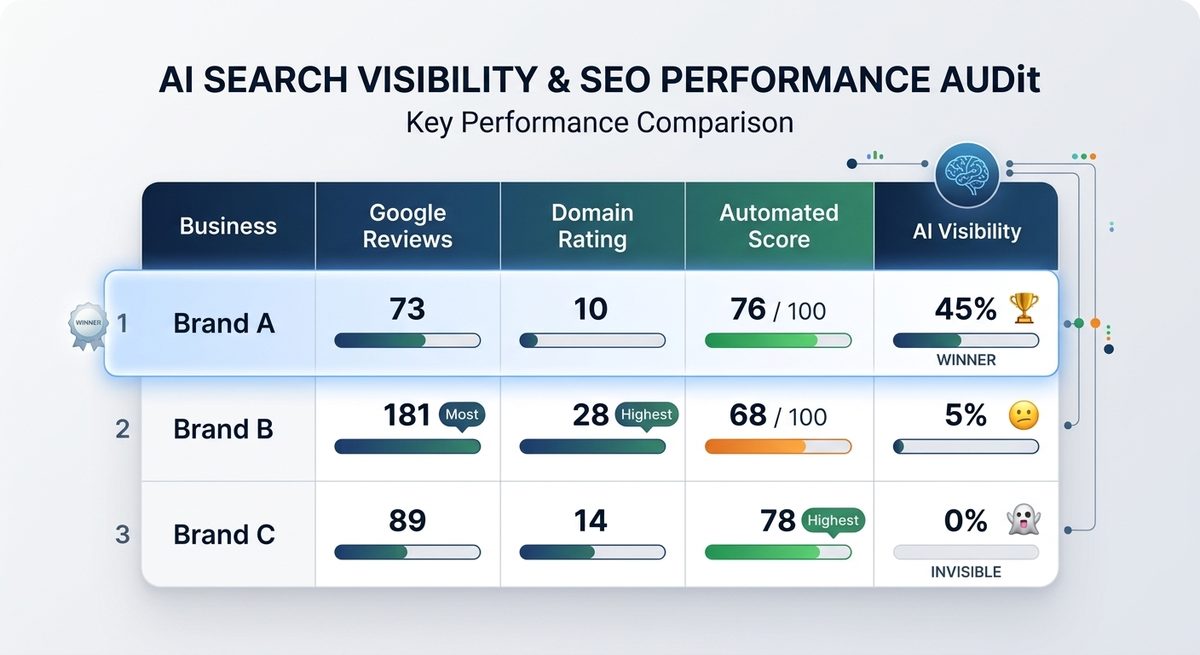
| Business | Google Reviews | Domain Rating | Automated Score | AI Visibility |
|---|---|---|---|---|
| Brand A | 73 (fewest) | 10 (lowest) | 76 / 100 | 45% — winner |
| Brand B | 181 (most) | 28 (highest) | 68 / 100 | 5% |
| Brand C | 89 (mid) | 14 (mid) | 78 (highest) | 0% — invisible |
- Reviews didn't decide it: Brand B had more than double Brand A's reviews — and was virtually invisible.
- Domain Rating didn't decide it: Brand B carried nearly triple the authority metric — and lost badly.
- Automated tools didn't decide it: Brand C scored highest on an automated GEO-readiness index (78/100) yet was cited 0% of the time.
Forensic Insight: Filtering the False Positives
Automated tooling actively misled the diagnosis. During Brand C's crawl, an audit tool flagged 30+ "orphaned pages" — the kind of alarming finding that triggers hours of unnecessary remediation on a junior report.
Manual review told a different story: those URLs were standard paginated archive pages from older blog content — not broken, not orphaned. Separating a real defect from a scanner false-positive is exactly where 15 years of hands-on crawl experience replaces a dashboard score. The tool measured the wrong thing; the human isolated the right one.
Root-Cause Diagnosis: Query Fan-Out & Entity Legibility
When a buyer asks an LLM a complex question ("Who are the best design-build contractors in [City]?"), the engine fans out — decomposing the prompt into sub-queries (timeline, cost per square foot, permitting) and retrieving a distinct, extractable source for each before synthesizing one answer.
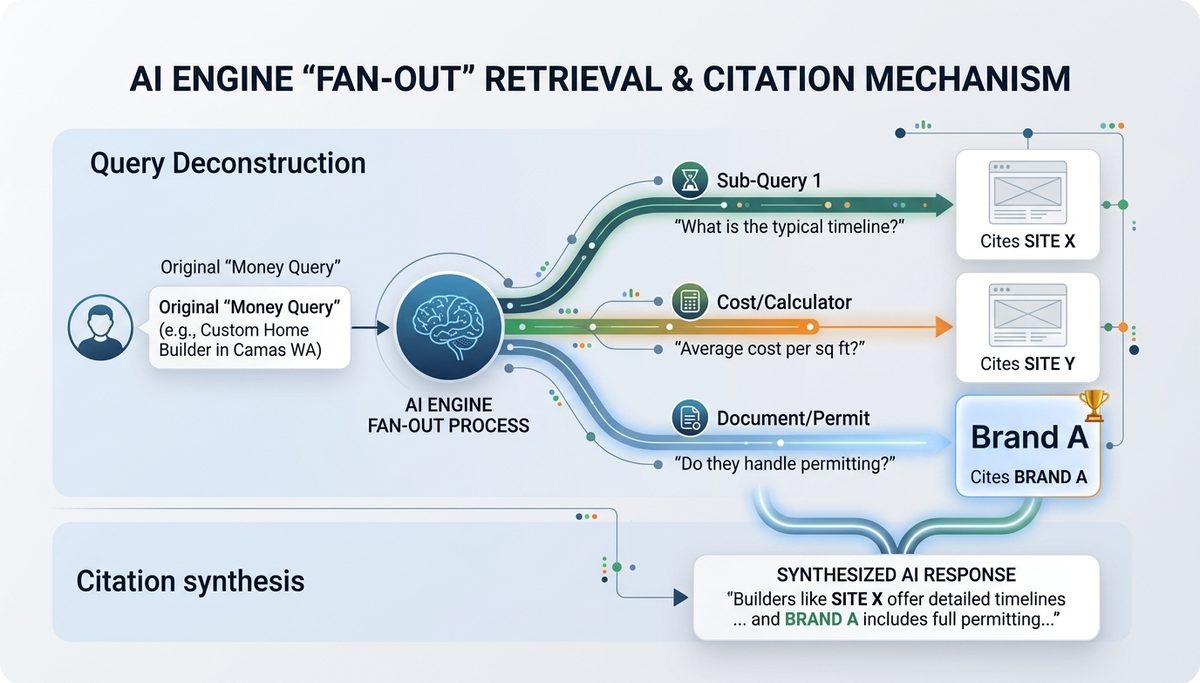
Brand C had genuinely strong material — awards, project showcases, community guides — but it was published in gallery and announcement formats, not answer-structured or schema-connected content. The raw expertise existed; the engines simply had nothing extractable to cite. The deciding variable wasn't authority or volume. It was entity legibility.
The Remediation Blueprint
Diagnosis is half the engagement; the fix is a staged, technical build I structure across four phases:
1 · Entity & Technical Architecture
Connected JSON-LD @graph chains (LocalBusiness → Service → FAQPage → Person) unified via sameAs nodes, consolidating split-market identities.
2 · Fan-Out Content Optimization
Answer-shaped money pages: question-framed H2s, concise extractable lead paragraphs, and explicit E-E-A-T author signaling built for LLM parsing.
3 · Managed Off-Page Authority
Field-level NAP corroboration across regional directories and aggregators, plus digital PR placement in the editorial listicles AI engines reference.
4 · Continuous Tracking & Defense
Re-scanning citation rates across ChatGPT, Perplexity, Gemini, and Google AIO to track visibility movement and defend hard-won citations.
Skillset Demonstrated
Want this teardown run on your brand or client portfolio?
I run this diagnostic white-label for agencies and directly for high-ticket local businesses. Read the full public breakdown, or get in touch.